
Policy
Research-driven solutions for strengthening America's productive economy by restoring Economic Parity to Agriculture
The Issue
To understand how we have sunk into this economic morass, we have to step back for a moment and look at the economy in fundamental terms.
The American economy begins with raw materials. Without a continuous supply of raw materials, productive sectors cannot produce, consuming sectors cannot consume, and exchanges of goods and money cease. The economy grinds to a halt.
The whole of the American economy depends on the primary suppliers, the industries that produce raw materials; namely agriculture, lumber, fishing, and mining. When these raw materials are receiving equitable prices at the point of first sale into the economy, the whole economy is healthy. But if they are receiving substandard prices, their debility handicaps us all.
America's pattern of indebtedness originates in the primary-supply sector. Farming, which represents 70% of the primary-supply production, best demonstrates the causes and the consequences of debt.
The value of crude oil production in our economy is undeniable, yet most want lower fuel prices. However, if crude oil was valued below the cost of production, gas prices would be at $.40/gallon. That would be great in the short term, but it is completely unsustainable and would result in a loss hundreds of billions of dollars in the U.S. economy.
U.S. farm industry is three times larger than oil and has been operating below the cost of production since 1954.
1aAgricultural productivity has increased dramatically.
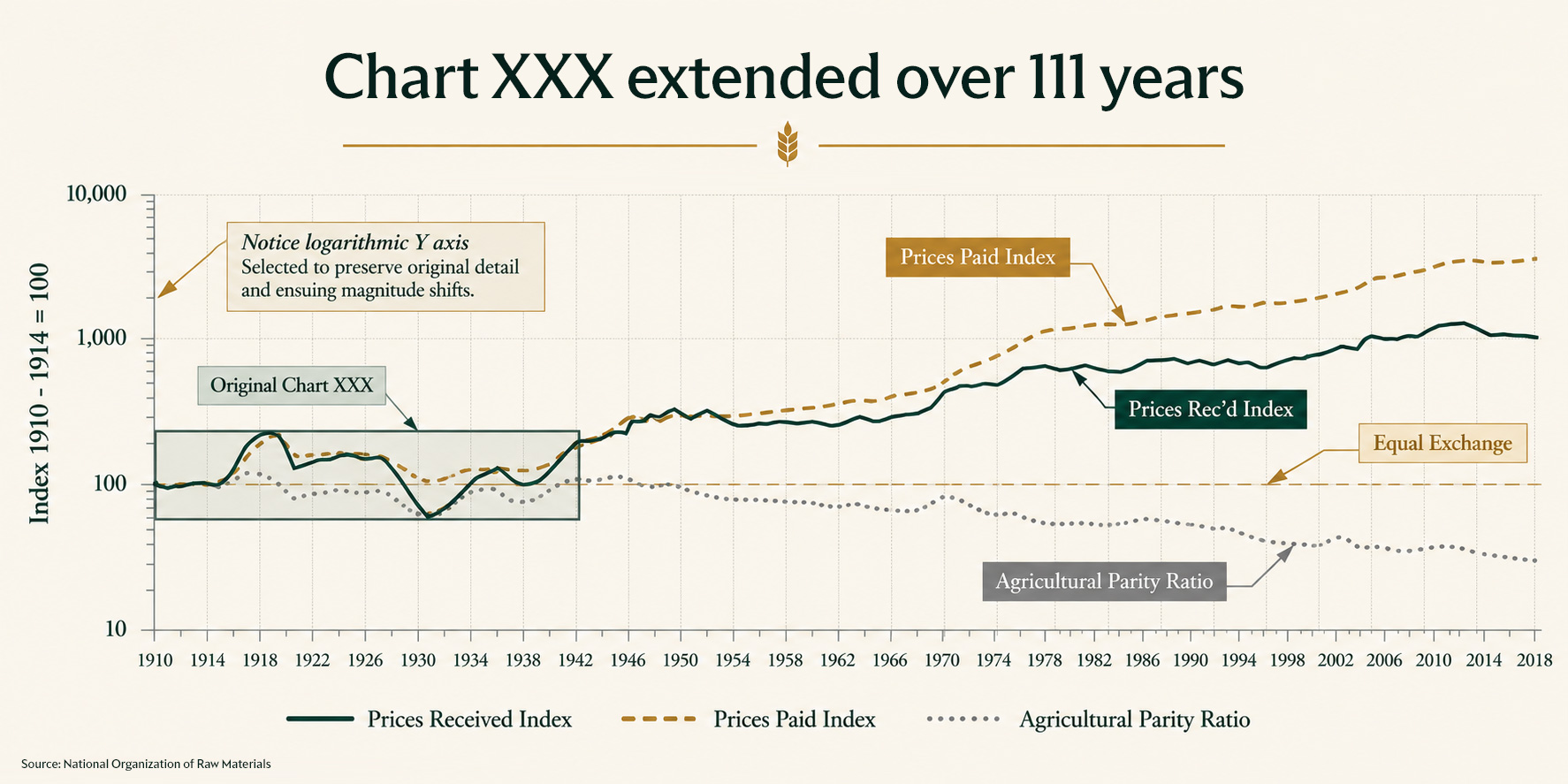
1bBut the economic return to agriculture has not kept pace.
Agriculture is one of America's biggest technological success stories. Not only does the United States feed itself abundantly; it is also the world's largest food exporter. If farmers and ranchers stopped producing, starvation would spread throughout the world. The reason for America's premier position is productivity based on sophisticated agricultural techniques and mechanization. At the end of World War II, one farm worker produced enough to feed 14 people. Now that same farm worker can fill 50 or more hungry mouths.
Yet, despite this enviable record, agricultural earnings have fallen. Today's sophisticated farming industry earns less per acre in real dollars than its much-less-productive post-World War II counterpart. The culprit in agriculture's downturn is commodity prices. In 1950, commodity prices were strong. The ratio of prices farmers received for factors of production to the prices they paid for their crops – a figure called parity ratio – was about 100, as measured by the United States Department of Agriculture. By 1980, the parity ratio had fallen to 64, and currently sits at 32%.
Agriculture has been squeezed tight by prices falling relative to expenses. Because agriculture earns less income than it needs to support itself, farmers must borrow. Between 1950 and 1980 the ratio of debt to equity in agriculture more than tripled. This swelling burden of debt decreased the number of farms, cut personal income to agricultural entrepreneurs, and shrunk the farm tax base.
Why It Matters
2aAgricultural income doesn't stop at the farm gate.
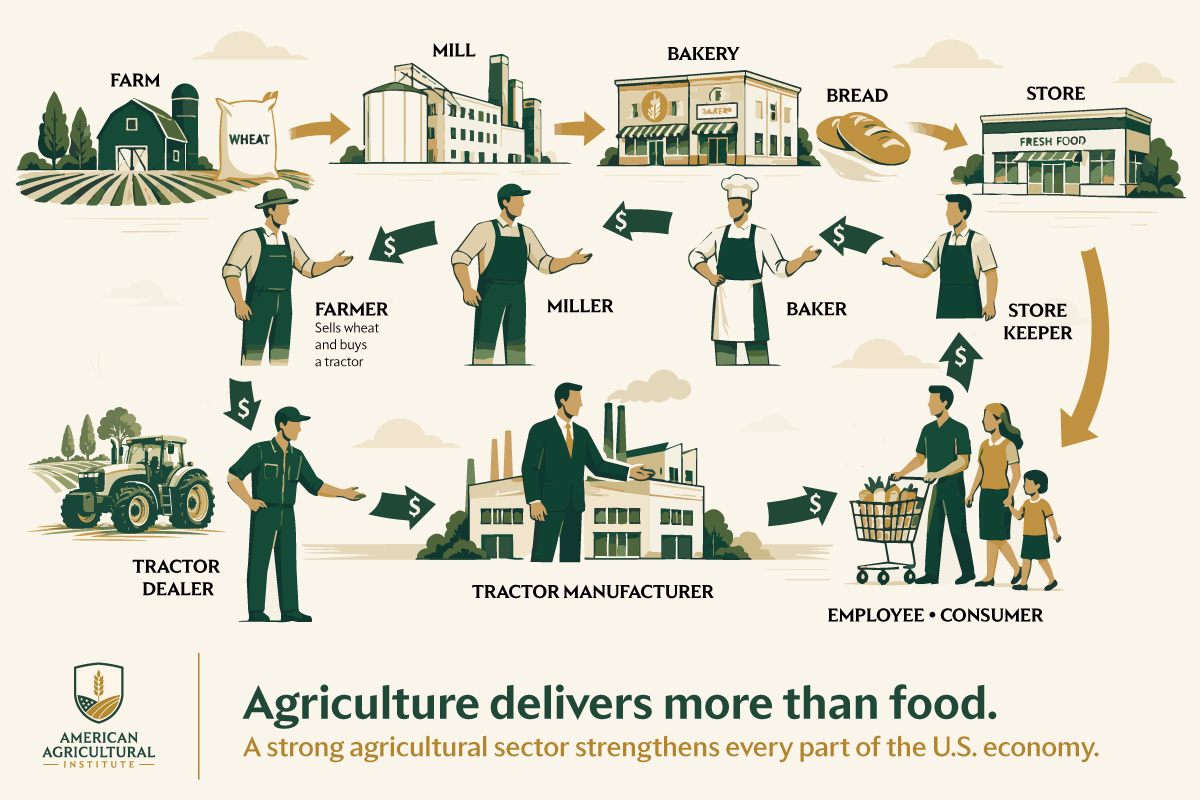
2bIt circulates throughout the American economy.
The debt that afflicts the entire American economy, from the household budget to the federal deficit, actually originates in agriculture's cycle of inescapable indebtedness.
The economy begins with primary supply. All economic sectors depend ultimately on extracted raw materials. What is true of physical production is also true of the flow of money. The economy's many exchanges of money begin in the primary supply sector's use of the money it receives for raw materials to pay for such production factors as rent, capital investment, amortization, and so forth. The firms and individuals that receive this money use it to pay for their own factors of production. The recipients of this money also use it to pay for production factors. On and on the cycle goes.
The money cycle is the basis of what economists call the “multiplier effect”. It is an accepted fact that every dollar received as gross raw material income in a given year enters 13 subsequent exchanges; in a sense, $1 becomes $13.
The multiplier effect is the key to understanding the central role of the primary-supply sector in the economy. Production begins in the primary-supply sector; so does the flow of money. If the primary-supply sector receives adequate income, then all the other sectors will receive adequate income. But if there is a shortfall in primary-supply sector income, then everyone down the line also comes up short.
This is exactly what's been happening. Low commodity prices have cut agricultural income; and, in turn, the income of every other sector and industry. For each $1.00 agriculture loses, the economy's money cycle loses $13. The evidence is all around us, in long unemployment lines, shuttered factories, rising debt, and strangling interest rates. Something – the right thing – must be done. In 2024, the one year underpayment to the agriculture industry was just over $1 trillion; equating to a $13 trillion loss to the national economy.
The Key Policies
If economic policy is to succeed, it must aim at the root cause of the current malaise: primary-supply depression. We need a new policy focus.
The health of the primary-supply sector determines the health of the whole economy. Revitalizing primary supply means increasing gross income. And that means equitable raw materials prices.
3aThe primary-supply sector determines the health of the whole economy.
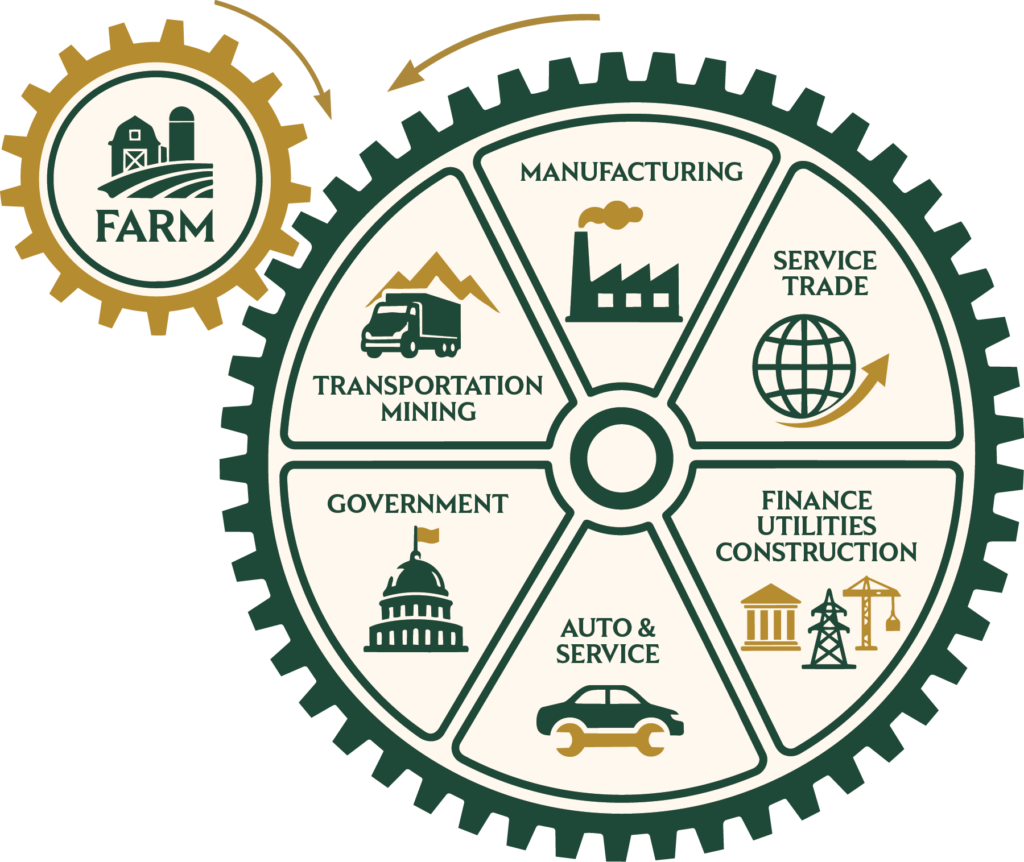
3bPolicy must address primary supply depression.
01 . Parity for Agriculture | Agricultural prices and industrial prices must be brought into balance by basing them on a common index.
Prices for storable foodstuffs and fiber (corn, wheat, cotton, barley, soybeans, rice, grain sorghum, and other agricultural commodities selected by the USDA) will be set at a minimum of 90% of parity and a maximum of 110% of parity.
These prices will be based on USDA figures drawn from the 1910-1914 base period, and they may fluctuate within the limits as the market demands.
02 . Tariffs at Parity | The parity thus established must be protected by means of tariffs geared to the same index to prevent foreign products from coming into the United States and underselling products of domestic origin, thereby breaking prices in the home market.
Imports of the primary-supply products must be priced domestically at 110% parity to prevent the domestic market from being flooded by cheap commodities from abroad.
Ultimately, these policies will work to the benefit of raw materials producers overseas, by guaranteeing them a fair and adequate price for their products and thereby establishing their economics on the firm foundation needed for sound economic development. This policy allows us to maintain domestic purchasing power of our money regardless of attempted manipulations by foreign powers.
03 . New Industries | Any surpluses of agricultural raw materials not needed for human consumption or which cannot be sold in the world markets, and to absorb industrial labor rendered idle by technological improvements in industry must be invested into new industries to consume for nonfood and nonfabric purposes.
During the early growth of the United States, new industries were a natural result of the abundance of raw material supplies of all kinds. This growth can be even further encouraged with modern advancements in technology.
Conclusion
These policies will help the whole economy, from the firms that produce primary-supply products to their ultimate consumers. With a fair price structure ensuring both an abundant supply of raw materials and the personal and corporate income needed to purchase them, the economy will provide growth and prosperity for all.